Showing posts sorted by relevance for query Processor. Sort by date Show all posts

Thursday, December 21, 2006

What's next for AMD?

by Jon Stokes

What's next for AMD?In a series of announcements and conference calls, culminating in a recent analyst meeting, AMD has been slowly revealing pieces of the big picture regarding where they plan to take their platforms in the coming years. I've been following the coverage, and I've put together a synthesis of it below.

Fusion and Torrenza: die-level vs. board-level

AMD's long-term plan appears to go as follows. First, they'll push Torrenza as a platform for doing board-level integration with specialized coprocessors. This way, system builders will have the option of tailoring systems to particular workloads by changing the mix of processors that inhabit the coherent HyperTranspoort sockets on a motherboard.

So for instance, for a four-socket motherboard, one customer may want two stream processors and two multicore general-purpose processors (i.e., Opteron or Athlon), while another may want one Java + XML coprocessor and three multicore general-purpose processors. Thus, system builders can mix and match to get the best performance per watt per dollar for the type of workload that their customers typically run.

Fusion and die-level integration

AMD also plans to do the same type of mix-and-match strategy at the level of the processor die by offering an array of heterogeneous multicore parts that fit different workloads. A "quad-core" processor from AMD might have two general-purpose cores and two specialized processor cores (e.g., a stream processor and a Java + XML coprocessor), one general-purpose core and three specialized cores, and so on. AMD refers to these specialized computing cores as application processing units (APUs), and they plan to develop an array of such application-specific, modularly designed cores that can be dropped onto a die and fabbed with minimal cost.

In addition to modular processor cores that can be mixed and matched to suit different application types, AMD also plans to make other parts of the processor modular, as well. Specifically, the processor will host one or more HyperTransport modules and other I/O interfaces, a memory controller, different levels and amounts of cache, and so on.

All of this die-level mixing and matching goes by the name of Fusion, with the result that Fusion and Torrenza are essentially the same idea, but at the die level and board level respectively.

AMD would like to use the Fusion/Torrenza combo to escape an n-core race with Intel. When you consider the fact that Intel's approach to the nascent n-core race, in which the company starts out with package-level integration before moving to die-level integration, leaves them perpetually ahead of AMD in terms of cores-per-socket, it's easy to see why AMD doesn't want an n-core race to replace the MHz race.

So will AMD's flexible, mix-and-match, Fusion/Torrenza approach beat Intel's brute-force multicore approach over the medium term? It's really hard to say at this point, but the question is worth thinking about from a historical perspective.

Integration and reincarnation

To understand the ebb and flow of the modern (post-integrated circuit) history of computing, you need to know three fundamental rules that govern the evolution of computing systems:

  1. Moore's Law: die-level integration is cheaper than board-level integration, and it gets ever cheaper as transistors shrink.
  2. The abstraction vs. specialization tradeoff: modularity and abstraction can be cheaper (depending on the amount of overhead involved), but specialization is almost always faster.
  3. Sutherland's "wheel of reincarnation": generally speaking, it's cheaper to do things with a combination of software and general-purpose hardware than it is to do them with specialized hardware, but sometimes the market demands faster instead of cheaper (see Rule #2). So functionality will move from the processor die to a dedicated coprocessor for speed's sake, and then back on to the processor die when the coprocessor becomes bloated with features and too expensive.

Let me take these three rules one at a time, and discuss their implications for AMD's overall strategy.

Rule #1 above may not look like the traditional formulation of Moore's Law, but if you've read my article on Moore's Law then you know that the traditional formulation doesn't look much like what Moore actually said. In fact, I think that my formulation here actually captures Moore's larger point, which was a point about the economics of integration, than does the traditional "transistor densities double every 18 months" phrase.

At any rate, this rule is the number one factor working against AMD's QuadFX initiative, which is basically a pitch to sell board-level integration using coherent HyperTransport and PCIe. The overwhelming economic advantages of die-level integration will forever relegate platforms that rely on board-level integration to more specialized niches. These specialized niches are profitable, but the really huge money is in the mass market, and the mass market has an endless appetite for die-level integration.

So the result of rule #1 for AMD's grand strategy is that Torrenza is a niche server/workstation technology, while Fusion could be used in everything from the high end of the market all the way down to mobile devices. The economics of microprocessors dictate that this is and will always be the case.

Rule #2 may mean that Fusion-based parts are generally slower and cheaper than whatever kind of specialized hardware that Intel is producing at the moment. I say this, because Fusion's basic idea of a library of modular functional blocks that are mixed and matched for different implementations seems to imply the heavy use of automated layout tools, with less process- and clockspeed-friendly customization. So the question for Fusion is, how much performance- and profit-killing overhead is implied in the modular design, and is the tradeoff worth it in terms of cost?

My point here is that the main way that Fusion is interesting is as a way to do performance per dollar (and per watt), and not raw performance. Note that this characterization is as true for servers as it is for, say, mobile phones. Leaving coprocessors on the system board (i.e., Torrenza) will probably make for better raw performance in most cases.

The other, closely related issue with such modular designs (software or hardware) is that they're forward-looking, with the idea being that an up-front investment in modularity and flexiblity will pay off over a projected long term scenario in which flexibility is important. But what if flexibility turns out not to be very important? Specifically, what if there are really only two or three types of functionality that will ever be worth putting on a processor die?

Put differently, AMD has pitched this idea of an APU as a sort of placeholder, and invited all of us to imagine many different types of specialized coprocessors that people will want to put on the CPU die. To help jump-start our imaginations, they've offered up the GPU as an example of functionality that's headed for the processor die in the very near future. Then, they have a few more minor, "hey, someone might do this" examples, like Java + XML processors and physics processors. But what if it turns out to be the case that the GPU—or, rather, a generic stream processor—is really the only specialized kind of coprocessor that's worth putting on the CPU die for the forseeable future? What if it turns out that there's essentially no such thing as an "APU," because in the real world all "APUs" are just stream processors?

This last point brings me to rule #3, the wheel of reincarnation. Sutherland's original observation that functionality moves back and forth between the main microprocessor and specialized, off-die hardware was originally made with respect to graphics processing. And indeed, graphics processing is really the only domain I can think of where the observation has consistently held true. So it's not insane to think that GPU functionality is ultimately the only thing that will continue to make that transition.

But maybe I'm wrong, and there are other specialized coprocessors that could profitably make the jump onto the CPU die. (Notice the word "profitably," because I'm sure there are some that could do so unprofitably, where the market wouldn't reward the time spent developing and implementing it.) If you can think of some other examples, post them in the discussion thread.

(c) www.arstechnica.com

Thursday, March 22, 2007

Raytheon Develops World's First Polymorphic Computer

EL SEGUNDO, Calif., March 20, 2007 -- The world's first computers whose architecture can adopt different forms depending on their application have been developed by Raytheon Company (NYSE: RTN).

The architecture of the MONARCH processor with key elements identified

Dubbed MONARCH (Morphable Networked Micro-Architecture) and developed to address the large data volume of sensor systems as well as their signal and data processing throughput requirements, it is the most adaptable processor ever built for the Department of Defense, reducing the number of processor types required. It performs as a single system on a chip, resulting in a significant reduction of the number of processors required for computing systems, and it performs in an array of chips for teraflop throughput.

"Typically, a chip is optimally designed either for front-end signal processing or back-end control and data processing," explained Nick Uros, vice president for the Advanced Concepts and Technology group of Raytheon Space and Airborne Systems. "The MONARCH micro-architecture is unique in its ability to reconfigure itself to optimize processing on the fly. MONARCH provides exceptional compute capacity and highly flexible data bandwidth capability with beyond state-of-the-art power efficiency, and it's fully programmable."

In addition to the ability to adapt its architecture for a particular objective, the MONARCH computer is also believed to be the most power- efficient processor available.

"In laboratory testing MONARCH outperformed the Intel quad-core Xeon chip by a factor of 10," said Michael Vahey, the principal investigator for the company's MONARCH technology.

MONARCH's polymorphic capability and super efficiency enable the development of DoD systems that need very small size, low power, and in some cases radiation tolerance for such purposes as global positioning systems, airborne and space radar and video processing systems.

The company has begun tests on prototypes of the polymorphic MONARCH processors to verify they'll function as designed and to establish their maximum throughput and power efficiency. MONARCH, containing six microprocessors and a highly interconnected reconfigurable computing array, provides 64 gigaflops (floating point operations per second) with more than 60 gigabytes per second of memory bandwidth and more than 43 gigabytes per second of off-chip data bandwidth.

The MONARCH processor was developed under a Defense Advanced Research Project Agency (DARPA) polymorphous computing architecture contract from the U.S. Air Force Research Laboratory. Raytheon Space and Airborne Systems led an industry team with the Information Sciences Institute of the University of Southern California to create the integrated large-scale system on a chip with a suite of software development tools for programs of high value to the Department of Defense and commercial applications. Besides USC major subcontractors included Georgia Institute of Technology, Mercury Computer Systems and IBM's Global Engineering Solutions division.

Raytheon Space and Airborne Systems is the leading provider of sensor systems giving military forces the most accurate and timely information available for the network-centric battlefield. With 2006 revenues of $4.3 billion and 12,000 employees, SAS is headquartered in El Segundo, Calif. Additional facilities are in Goleta, Calif.; Forest, Miss.; Dallas, McKinney and Plano, Texas; and several international locations.

Raytheon Company, with 2006 sales of $20.3 billion, is an industry leader in defense and government electronics, space, information technology, technical services, and business and special mission aircraft. With headquarters in Waltham, Mass., Raytheon employs 80,000 people worldwide.

(c) www.shoutwire.com

Tuesday, December 26, 2006

Intel Pentium 4 Prescott costs just $70 Or grab a Prescott Celeron for $47

 by Fuad Abazovic

Intel LogoUS CPU prices today look realistic even compared to the mainland China consumer market.

The cheapest Core 2 Duo 6300 clocked at 1.86GHz LGA 775 Processor retail will cost only $183 retail. This boy can be heavily overclocked even with air cooling, some say to 2.6GHz or beyond.

But compared to other deals this is ultra expensive. You can get an Intel Celeron D 326 Prescott 2.53GHz LGA 775 for $47 only. This baby will be significantly slower but it is a quarter the price of a Core 2 Duo.

Intel's Pentium 4 511 2.8GHz LGA 775 RoHS version processor costs $70 retail. If you want a Pentium 4, a dual-core Intel Pentium D 805 Smithfield at 2.66GHz LGA 775 processor (Model HH80551PE0672MN OEM version) you will need to spend $89.

The Vista upgrade market can only be super-thrilled and happy as less than $100 bucks will get you a decent CPU.

All of these details are here so go and make your Yule. Newegg might even ship it to you before Yule Monday

(c) www.theinquirer.net

Thursday, June 7, 2007

Quick and Dirty AMD K10 Cinebench

by Kristopher Kubicki

An early AMD "Barcelona" revision gets its first non-simulated benchmark


Earlier today, AMD announced that it successfully demonstrated Barcelona across the server market. The company did not publically state how fast the processor was running, the stepping of the processor, the processor thermal envelope or the eventual ship date.

We had the opportunity to benchmark the AMD Barcelona, native quad-core on an early stepping. We only had a few minutes to test the chip, but we were able to run a quick Cinebench before we were instructed to leave.

The AMD benchmark ran on a single-socket, K10 CPU running at 1.6 GHz on NVIDIA's nForce Professional 3400 chipset. According to the system properties, the AMD system used 4GB of DDR2-667.

The most similar Intel system we could muster up on such short notice was an Intel Xeon 3220. The Xeon X3220 is clocked at 2.4 GHz, and ran on Intel's Garlow platform (Intel X38). This system property profile stated the system utilized 4GB of DDR2-800.

Cinebench completed the default benchmark in 27 seconds for the 1.6 GHz K10; 17 seconds for the Intel Xeon X3220. The Kentsfield Xeon was 58% faster with a 50% higher clock frequency for Cinebench.

Both systems ran Windows 2003 R2, 64-bit.

AMD partner engineers tell DailyTech the chip we tested was the latest revision silicon. The same engineers claim 2.0 GHz Barcelona chips are making the rounds, with 2.3 GHz already on the desktop and server roadmaps.

AMD's current guidance suggests a late July announcement for Barcelona. However, when DailyTech tracked down the individual partners named in AMD's press release, all cited "optimistic September" ship dates for motherboards.

(c) www.dailytech.com

Saturday, January 6, 2007

Three Intel quad-cores coming Monday

http://www.idc.com.tw/Event/InfrastructureVision2005/Intel%20logo.gifIntel plans to launch three quad-core processors on Monday, covering two Xeons for lower-end servers and one mainstream model for desktop computers, sources familiar with the plan said.
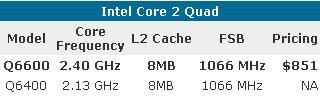
As expected, the desktop chip is called the Core 2 Quad 6600 and will join the Core 2 Extreme QX6700 model Intel already ships. The new processor will run at 2.4GHz, and the front-side bus that links the chip to the rest of the system will run at 1066MHz, the company is expected to announce at the Consumer Electronics Show in Las Vegas next week.

Also set to arrive are two low-end Xeons, the 2.13GHz 3210 and 2.4GHz 3220. Both are designed for single-processor servers. The chips have 8MB cache and a 1066MHz front-side bus.

Intel declined to comment for this story.

The chipmaker began its quad-core product launch in November but now is fleshing out the lineup. It often launches desktop products with extreme models geared for demanding video game systems, then adds more moderately priced mainstream models later.

"I expect, with respect to the desktop quad-core, it's mostly a matter of maintaining a certain cadence, even if, practically speaking, there won't be a whole lot of near-term buyers," Illuminata analyst Gordon Haff said.

Intel's quad-core processors combine two dual-core chips into a single package. Rival chipmaker Advanced Micro Devices has a quad-core processor code-named Barcelona under development that puts all four cores on a single slice of silicon. However, that chip won't arrive until midway through this year.

Servers, which often juggle multiple independent tasks, are well-suited to taking advantage of multiple processing cores. With desktop machines, however, the benefits aren't as clear because software often isn't able to use all the cores effectively.

(c) news.com.com

Sunday, December 24, 2006

New Core 2 Processors Around the Corner

Intel's roadmap adds more quad-core and value dual-core in the pipeline

It’s been a while since Intel last made notable updates to its desktop processor roadmap. Last month DailyTech revealed Intel is expected to launch a variety of new Core 2 Duo and Pentium E 2100 processors including refreshed Conroe based products next year. Intel’s latest desktop roadmap reveals more new processors and removes some previously reported models.

 New Core 2 Processors Around the Corner

Intel is expected to release its first mainstream quad-core Core 2 Quad Q6600 early next year. The processor is still on track for a Q1’2007 launch with an $851 per-unit in 1,000 unit quantities price tag. While this may seem a bit steep, Intel is expected to cut the price of the Core 2 Quad 6600 down to $530 per-unit in 1,000 unit quantities when Q2’2007 rolls around.

The Intel Core 2 Quad Q6600 won’t be the only one in the Core 2 Quad family though. Somewhere between Q2’2007 to Q3’2007 Intel will add one more member to its Core 2 Quad family. This will arrive as the Core 2 Quad Q6400. The Core 2 Quad Q6400 will be clocked at 2.13 GHz and operate on a 1066 MHz front-side bus. It will have an 8MB L2 cache with support for Intel VT, Enhanced Intel Speedstep, Intel EM64T and NX bit technologies.

  New Core 2 Processors Around the Corner

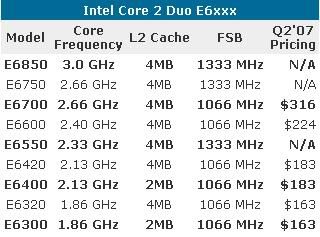
Moving onto the dual-core product roadmap Intel has made a few changes to its latest roadmap. Gone from the latest roadmap is the Core 2 Duo E6390 which was essentially a Core 2 Duo E6400 with Intel VT and vPro extensions disabled. The previously reported Intel Core 2 Duo E6650 has been renamed in the latest roadmap. The latest roadmap has renamed the Core 2 Duo E6650 to Core 2 Duo E6550. Aside from the naming changes it remains a 1333 MHz front-side bus processor clocked at 2.33 GHz.

Previous roadmaps have indicated that 3.0 GHz Core 2 Duo processors will be available next year as well. Currently, this remains unchanged.

New to this roadmap are new Intel Core 2 Duo E6420 and E6320 processors. These processors are clocked at 2.13 GHz and 1.86 GHz like the Core 2 Duo E6400 and E6300. However, the Core 2 Duo E6420 and E6320 will have 4MB of L2 cache instead of the 2MB found on the Core 2 Duo E6400 and E6300. The two processors are expected to launch in Q2’2007. Pricing for the Core 2 Duo E6420 and E6320 will be $183 and $163 in 1,000 unit quantities respectively.

  New Core 2 Processors Around the Corner

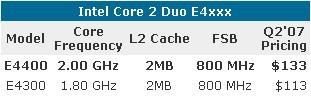
Since the Core 2 Duo E6420 and E6320 are endowed with 4MB of L2 cache this leaves room for the new Core 2 Duo E4x00 series processors. It was previously reported the Core 2 Duo E4x00 series was expected to have two models—the Core 2 Duo 4400 and 4200. However the roadmap has changed and the Core 2 Duo E4200 has been scrapped. Nevertheless in place of the Core 2 Duo E4200 is a new E4300. The Core 2 Duo E4300 is clocked at 1.8 GHz on an 800 MHz front-side bus. It’s expected to launch late January with pricing starting at $163 in 1,000 unit quantities. The Core 2 Duo E4300 is expected to have a one year life cycle with a product discontinuance notice expected in Q4’2007 and reach end-of-life in Q1’2008.

Joining the Core 2 Duo E4300 will be the Core 2 Duo E4400. The Core 2 Duo E4400 is expected to arrive in Q2’2007. It will be clocked at 2.0 GHz and priced at $133 in 1,000 unit quantities. With the launch of the Core 2 Duo E4300 in Q2’2007, Intel is expected to slash prices on the Core 2 Duo E4300 down to $113 in 1,000 unit quantities.

(c) www.dailytech.com

Monday, January 1, 2007

Early AMD ATI "R600" Specs, Benchmarks Leaked

ATI logo

Details of AMD's next generation Radeon hit the web

Newly created site Level 505 has leaked benchmarks and specifications of AMD’s upcoming ATI R600 graphics processor. The upcoming graphics processor is expected to launch in January 2007 with an expected revision arriving in March 2007. These early specifications and launch dates line up with what DailyTech has already published and are present on ATI internal roadmaps as of workweek 49.

Preliminary specifications from Level 505 of the ATI R600 are as follows:

  • 64 4-Way SIMD Unified Shaders, 128 Shader Operations/Cycle
  • 32 TMUs, 16 ROPs
  • 512 bit Memory Controller, full 32 bit per chip connection
  • GDDR3 at 900 MHz clock speed (January)
  • GDDR4 at 1.1 GHz clock speed (March, revised edition)
  • Total bandwidth 115 GB/s on GDDR3
  • Total bandwidth 140 GB/s on GDDR4
  • Consumer memory support 1024 MB
  • DX10 full compatibility with draft DX10.1 vendor-specific cap removal (unified programming)
  • 32FP [sic] internal processing
  • Hardware support for GPU clustering (any x^2 [sic] number, not limited to Dual or Quad-GPU)
  • Hardware DVI-HDCP support (High Definition Copy Protocol)
  • Hardware Quad-DVI output support (Limited to workstation editions)
  • 230W TDP PCI-SIG compliant

This time around it appears AMD is going for a different approach by equipping the ATI R600 with less unified shaders than NVIDIA’s recently launched GeForce 8800 GTX. However, the unified shaders found on the ATI R600 can complete more shader operations per clock cycle.

Level505 claims AMD is expected to equip the ATI R600 with GDDR3 and GDDR4 memory with the GDDR3 endowed model launching in January. Memory clocks have been set at 900 MHz for GDDR3 models and 1.1 GHz for GDDR4 models. As recent as two weeks ago, ATI roadmaps had said this GDDR3 launch was canceled. These same roadmaps claim the production date for R600 is February 2007, which would be after a January 22nd launch.

Memory bandwidth of the ATI R600 is significantly higher than NVIDIA’s GeForce 8800-series. Total memory bandwidth varies from 115GB/s on GDDR3 equipped models to 140GB/s on GDDR4 equipped models.

Other notable hardware features include hardware support for quad DVI outputs, but utilizing all four outputs are limited to FireGL workstation edition cards.

There’s also integrated support for multi-GPU clustering technologies such as CrossFire too. The implementation on the ATI R600 allows any amount of ATI R600 GPUs to operate together in powers of two. Expect multi-GPU configurations with greater than two GPUs to only be available for the workstation markets though.

The published results are very promising with AMD’s ATI R600 beating out NVIDIA’s GeForce 8800 GTX in most benchmarks. The performance delta varies from 8% up to 42% depending on the game benchmark.

When DailyTech contacted the site owner to get verification of the benchmarks, the owner replied that the benchmark screenshots could not be published due to origin-specific markers that would trace the card back to its source -- the author mentioned the card is part of the Microsoft Vista driver certification program.

If Level505's comments seem a little too pro-ATI, don't be too surprised. When asked if the site was affiliated in any way to ATI or AMD, the owner replied to DailyTech with the statement that "two staff members of ours are directly affiliated with AMD's business [development] division."

(c) www.dailytech.com

Friday, December 22, 2006

Dungeon & Fighter PC

Dungeon & Fighter PC

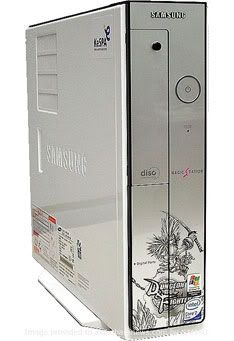
You might not have heard about Dungeon & Fighter, but it is a shoot 'em up from Korea that is wildly popular. Samsung has created a gaming rig that pays homage to that fast and furious shooter, but the model number could do with a rename. Known as the DM-Z60/Sport PC, it is powered by an Intel Core 2 Duo processor and comes with an entry-level SLI video card. The popularity of this game has even spilled over to Japanese shores and it is known as Arad Senki there. Those who love the game ought to start saving some money today in order to get a matching computer. Pricing details are unavailable though.

(c) www.ubergizmo.com

Monday, December 25, 2006

Dell hints at "Black Ice" technology

Dell hints at

Dell today posted an update to its XPS 710 website referencing a technology only known as Black Ice. The company makes an allusion to a "cold front" but does not reveal more than a teaser image. Sources, however, suggest that Black Ice may be a phase change cooling system similar to that of asetek's Vapochill cases, which dramatically reduce the temperature of the system beyond even liquid cooling. The improvement would let Dell overclock even the hot-running Core 2 Extreme four-core processor without affecting other components. The system builder has not committed to an unveiling date but may reveal Black Ice in time for the CES expo in early January.

Earlier this year, Dell released a special edition XPS system known as the Renegade which featured an overclocked, factory-warrantied Pentium 4 as well as a then special quad-SLI video card offering.

(c) www.electronista.com

Wednesday, February 13, 2008

Dell Doesn't Want to Sell AMD Anymore

It seems Dell Company has disappointed in AMD based desktop computers and now seriously shrinks its stock of AMD related consumer products. Confirming this Dell announce that now you can't buy AMD based computer on Dell's website. And you can get such a computer only by phone or in offline shop.

Dell desktop AMD based computer

This news rushed down AMD shares immediately.  Shares felt on 4.7% to cost as low as $6,28 per share. It was just a excuse because the market was waiting for some bad news about AMD for 2 weeks already. Dell claims that it affects only website and AMD products may come back at any moment.

Dell is second in rating of world's leading computer manufacturers. It started to assemble desktop computers with AMD processors in may 2006. Now you can find only one desktop computer with AMD processor on the Dell website: Dell OptiPlex 740. Server solutions are not affected now.

Thursday, December 7, 2006

Nvidia unveils nForceR 680a SLI MCP

Nvidia introduced its new nForce 680a SLI media and communications processor (MCP), designed specifically for the new AMD Quad FX Platform with Dual Socket Direct Connect Architecture.

The nForce 680a SLI MCP provides processing capabilities on a massive scale, by allowing users to harness the power of up to four GPUs, eight displays, 12 SATA hard drives, and four gigabit Ethernet connections, all from a single consumer desktop PC, according to the company.

The nForce 680a SLI MCP is a motherboard core-logic solution providing a host of technologies, which include support for Nvidia SLI multi-GPU technology, with four PCI Express slots that can be used to drive up to eight independent, high-resolution displays for extended work spaces and advanced networking and storage capabilities, including support for up to four gigabit Ethernet connections and 12 SATA hard drives for a combined eight terabytes of media storage, according to Nvidia.

Additionally, the nForce 680a SLI MCP has been architected to take advantage of the power behind the AMD Athlon 64 FX-70 series processors, allowing users to also run multiple multi-threaded, CPU-intensive applications simultaneously without compromising performance, according to the company.

[original post: www.digitimes.com]

Saturday, December 16, 2006

IBM, Intel develop virtualization performance benchmark

by Patrick Thibodeau

It's been offered to SPEC, which is developing an industry standard

December 15, 2006 (Computerworld) -- There are already industry benchmarks for CPUs, mail servers and a wide range of other IT technologies -- and by this time next year, virtualization users may have an industry-sanctioned benchmark.

Last month, Standard Performance Evaluation Corp. (SPEC) created a working group to begin development of a virtualization standard. And this week, IBM and Intel said they have offered a virtualization benchmark to the standards group for its consideration.

What IBM and Intel are offering is called vConsolidate, which measures processor and memory throughput efficiency on two or more servers.

Lorie Wigle, director of server technology marketing at Intel, said IT planning departments will be able to use the benchmark to simulate the workloads they are planning to consolidate and determine the best hardware platform for them. The joint Intel and IBM benchmark should be ready for users sometime in the first half of next year, she said.

Warrenton, Va.-based SPEC, a nonprofit company that has developed a wide range of IT benchmarks, set up a working group on virtualization that includes representation from the major vendors, including IBM, Intel, Advanced Micro Devices Inc., Dell Inc., Sun Microsystems Inc. and Hewlett-Packard Co. Virtualization software vendors are also expected to participate, and IT managers have been invited to contribute ideas to a standards process, according to SPEC.

A benchmark has to be consistent across all operating platforms and has to be "fair for everybody involved," according to SPEC spokesman Bob Cramblitt, who said parts of what the vendors contribute to the standards effort may be included in a final standard. "Nobody is going to let one vendor get away with something that might favor their particular configuration."

Jay Bretzmann, manager of System x product marketing at IBM, said the benchmark is now being used by other vendors. He said a tool for measuring performance across larger servers is needed because customers are putting tmore important and strategic workloads in virtualization environments.

[original post: www.computerworld.com]

Sunday, December 24, 2006

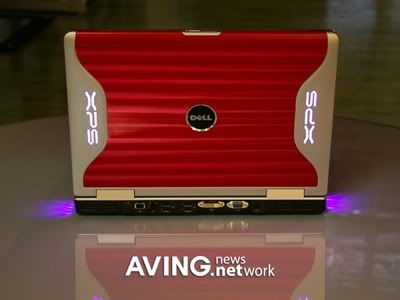
Dell to launch Blu-ray notebook pc 'XPS M1710' in Korea

Dell to launch Blu-ray notebook pc 'XPS M1710' in Korea

SEOUL, Korea (AVING) -- <Visual News> Dell International announced the launch of ' XPS M1710', its Blu-ray notebook pc in Korea market. It features Core 2 Duo processor T7600(2.33GHz/667MHz FSB/4MB L2 cache), 512MB dual channel 667MHz DDR2 SDRAM memory, 80GB(5400RPM SATA) HDD, and 9-cell batteries.

Suggesting price is 3,299,000(KRW-VAT not included) or 3,628,900(KRW-VAT included)

(c) www.aving.net

Thursday, December 21, 2006

A peek at Intel's upcoming roadmap

by Jon Stokes

A peek at Intel's upcoming roadmap

Two new rumors offer a peek at what's in the cards for Intel in 2007 and 2008. First up is a rumor from HKPEC that fleshes out the picture of the bottom end of Intel's lineup that has been emerging over the past few months. Specifically, we can now add more details of single-core Merom-based parts to what we've already heard about the single-core Conroe-L.

Previously, news had leaked out about a Merom-based Celeron M 520, which is supposed to be launched in January. (The brains of the rumored MacBook Thin, perhaps?) The new rumor brings news of a Celeron M 523 (933MHz) that will come out later in the year. This part, like the other Merom-based single core parts, is a 65nm Socket M part with a TDP of 5W.

Also fitting those same socket and TDP specs are two other Merom-based parts that will go under the "Core 2 Solo" moniker. These will sport higher clockspeeds and be sold under the U2100 (1.2GHz) and U2200 (1.06GHz) names. The Core 2 Solo parts are also due out in Q3 of 2007.

The news that these parts will be branded as "Core 2 Solo" makes me wonder if there's any truth to previously reported rumors that the single-core Conroe-L will be sold under the venerable Pentium brand name. Why would Intel revive the Pentium brand for single-core Conroe, while shipping single-core Meroms under the Core 2 Solo and Celeron brands?

In other Intel rumor news, VR-zone claims to have seen a roadmap that puts Intel past the 4GHz barrier in 2008. The chip that will break the barrier is allegedly the quad-core Bloomfield processor. Bloomfield has long been rumored to be a 45nm design that will use Intel's long-delayed common systems interconnect (CSI)—an answer to coherent HyperTransport that will also host the Itanium product family. Bloomfield is also a true quad-core part, in that all four cores sit on the same die and share an L2 cache.

I don't think that the 4GHz rumor sounds particularly implausible, given current clockspeeds on the 65nm process. However, I do wonder about part of the rumor that says they'll do it in the 130W power envelope.

(c) www.arstechnica.com

Tuesday, December 26, 2006

2006: The Year in PCs and Chips

From Macs running Windows to Justice Department probes to quad-core processors: 2006 was a busy year.

Vendors in the PC and chip industries moved boldly in 2006, changing the marketplace map through mergers, recalls, layoffs, and lawsuits. Oh, and they launched some impressive new products too, keeping Moore's Law moving as they built smaller, faster chips and cooler, more efficient computers. Here, in chronological order, we share a sampling of the biggest events of the past 12 months.

Apple Releases Macs That Run on Intel Chips

In January Apple Computer sold its first Mac PCs that run on chips from Intel instead of on chips from IBM and Motorola, fulfilling a promise made in June 2005. Apple substitutes Intel's Core Duo chip for the PowerPC and G4 chips in its iMac and 15-inch MacBook Pro, soon followed by the Mac mini and 13-inch MacBook.

The move also let Apple expand from its own operating system. In April, Apple launches its Boot Camp software, enabling Intel-based Macs to run their choice of Apple's OS X or Microsoft's Windows XP.

AMD Announces ATI Acquisition

In July Advanced Micro Devices announces it would buy Canadian graphics chip vendor ATI Technologies for $5.4 billion. Integrating its processors with ATI's chip sets would allow AMD to sell platforms of integrated technologies, competitive with Intel bundles like Centrino, Viiv, and VPro, analysts say. Another effect of the merger is to leave Nvidia as the only independent graphics chip vendor in the market.

By November, Nvidia also says it will expand, paying $357 million to buy PortalPlayer, a maker of semiconductors for digital music players.

Battery Recall Begins

Dell recalls 4.1 million notebook batteries in August as a growing number of customers report they could short-circuit, causing some to overheat and catch fire. Within days, other vendors join the recall, leading to 8.1 million recalls of the lithium ion cells manufactured by Sony. Other PC vendors affected by the largest recall in consumer electronics history include Apple, Fujitsu, Hitachi, Lenovo, and Toshiba.

Intel Reorganizes, Lays Off Thousands

In September, Intel lays off 10,500 workers--about 10 percent of the workforce--as Chief Executive Paul Otellini enacts a promised reorganization that has already included the sale of its media and signaling business, the firing of 1000 executives, and the sale of its XScale smart phone chip division. Otellini blames slowing growth in the PC market when he predicts Intel's annual profits will reach only $9.3 billion for 2006, down from $12.1 billion in 2005. Analysts point out that Intel had also lost revenue by slashing prices on its chips in an effort to slow gains in market share by rival AMD.

Justice Department Investigates SRAM Market

The Department of Justice launches a probe in October of sales practices in the SRAM memory chip market, serving subpoenas to Cypress Semiconductor, Mitsubishi Electric, Samsung Electronics, Sony Electronics, and Toshiba. The investigation comes shortly after the Justice Department wins convictions and multimillion-dollar fines for price fixing in the closely related DRAM industry. By December, the Justice Department also turns its focus to graphics chips makers, demanding documents from AMD and Nvidia as part of an antitrust investigation.

Meanwhile, AMD continues another antitrust fight, continuing its long-running suit against Intel over accusations that the much larger chip-maker intimidated vendors from using AMD chips. That case is scheduled to come before a judge in April 2009.

HP Tops Dell as World's Largest PC Vendor

Hewlett-Packard overtakes Dell in October as the world's largest PC vendor, capping a year when Dell had reported a series of sagging profits and the start of an accounting investigation by the U.S. Securities and Exchange Commission. HP has its own problems, coping with a spying scandal on its board of directors that leads to criminal investigations and the resignation of chief executive Patricia Dunn. But Dell is unable to stop its loss of market share even when the company ends its longtime allegiance to Intel and begins selling PCs powered by chips from AMD as well. Dell Chief Executive Kevin Rollins says the company was also hurt by slashing prices in order to bolster market share, and pledges to spend $100 million to hire more sales and call-center workers.

Intel Launches Quad-Core Processors for PCs

Intel launches the first quad-core processors for mainstream desktops and servers, continuing its effort to rebound from a loss of sales to AMD. The new chips include the Core 2 Extreme QX6700 for gamers and Xeon 5300 for servers, coming just a few months after Intel launches a new family of dual-core chips including the "Conroe" Core 2 Duo for desktops and "Woodcrest" Xeon 5100 for servers.

Still, the arms race continues, as AMD emphasizes its advantage in power efficiency and pledges to launch its own quad-core processor by the second quarter of 2007, the "Barcelona" quad-core Opteron 8000 for servers.

(c) www.pcworld.com

Tag Cloud